
The case of the Regional Court of Cologne, 33 O 39/20, concerned the acquisition of trade secrets through reverse engineering in the biological field (the acquisition of antibodies was at issue). The decision illustrates the – repeatedly underestimated – importance not only of well-worded contracts, but also of the actual conclusion of the contract. This decision in particular makes it clear that companies should pay very close attention to ensuring that their services, which are actually protected as trade secrets, do not unintentionally become fair game – it is finally time to wake up and stop treating the issue of trade secrets stepmotherly!
Lawyer for German arrest warrant – arrest warrant in Germany, what to do? What can a criminal defense lawyer or lawyer in Germany do in case of an arrest warrant? It is possible that you have suddenly learned that there is an arrest warrant against you in Germany, then the obvious question is how to deal with it. We will help you if you are affected by a German arrest warrant and also advise that you seek advice immediately and in no case also commit foolish acts.
What is space law – and space criminal law?
Juristically, the airspace above state territory is “domestic” in the sense of criminal law. However, this airspace ends at a certain altitude, where it becomes outer space. It is not clear where this boundary lies, but from an altitude of 80 kilometers, it is clear that space begins at 110 kilometers at the latest. This is not subject to any state sovereignty, is thus – at least spatially considered – not legally regulated.
If one asks for a space criminal law, the easy way is to think of space vehicles – these will be subject under international law to the sovereignty of the state for which they appear. It is therefore argued in the literature that one should explicitly extend the “flag principle” to spacecraft in §4 StGB and, moreover, that one should already do so in the interpretation. Otherwise, it applies to international space missions that each participating state has sovereignty over its property and its nationals.
Space law as a legal field currently exists probably more in legal theory than in practice. Serious problems arise in this context, which are currently still rather marginal: For example, on the protection of industrial property and the question of the protection of intellectual property of discoveries/inventions in outer space, which today can already partly be subject to national law.
Exemplary aspects of space law
Space Law
Since there is no national space law, space law is part of international law. The core element is the Space Treaty of 27. 1. 1967.
Liability
Of course, the question of liability must somehow be clarified, at least fundamentally. Here, the Outer Space Ordinance and the Outer Space Liability Convention are to be mentioned. The here (roughly) conceived liability system provides for a strict liability or a fault liability, depending on the place of damage (earthly or in space).
War & Cybercrime
How do you deal with hackers – possibly also on behalf of the state – attacking systems in space, such as satellites? Or use satellites to target earthly targets via connections running over them?
Lawyer for space criminal law and space law
- Specialist lawyer in IT law and criminal law, who loves legal issues of new technologies and technology in general
- Of course, no experience whatsoever in the courtroom with space law – as well as
- Extensive involvement with space law issues for many years, especially around technological and criminal aspects.
- Where technology and criminal law meet is in the area of cybercrime – specializing in cybercrime, it would be fatal not to see the threat of satellite-based connectivity here!

Space Criminal Law
Is there an original space criminal law?
There is no real, original criminal law for outer space in the sense that there is a directly created criminal law for outer space. There are some, very specific, special rules, for example if one operates a satellite system without the required authorization, which generates data about the Earth with a particularly high information content, which constitutes an administrative offense (see for example § 28 I Nr. 1 Satellitendatensicherheitsgesetz, “SatDSiG”).
However, there is a bridge to national criminal law: In the case of criminal offenses with a special domestic reference, criminal liability “abroad” can arise via §5 StGB, in the case of expressly named and particularly serious offenses. The term “abroad” covers everything that is not German territory, and according to the prevailing opinion in the legal literature, outer space is included without any problems.
Cybercrime in space
RA JF specializes in cybercrime – of course, the connection to space, with communications and surveillance via satellites is perfectly obvious.
Attacks that are coordinated against the home country and are only carried out via the “tool” in space are certainly well within the reach of national criminal law. Cases will be exciting in which, at the same time, directly intended or not, damage is caused to the respective property in space by the attack – which was intended to cause damage elsewhere on Earth.

Commitment in space
Engagement in space is of strategic importance to nation states and especially to supranational entities such as the EU. Engagement in space is of strategic, economic and scientific importance to nation states and the EU as a whole. Neglecting this sector could lead to geopolitical, economic, and security disadvantages. It is therefore crucial to invest in space technologies and missions and to play an active role in space, in particular in the areas of
- Science and Research: Space offers unique opportunities for scientific research, from exploring other planets and stars to exploring Earth from orbit. This research can expand our understanding of the universe and lead to breakthroughs in physics, biology, and other sciences.
- Technological innovation: The challenges of space flight have led to numerous technological advances, many of which also have applications on Earth, such as in medical technology, communications technology and materials science.
- Economic Opportunities: Space offers economic opportunities ranging from satellite services to space tourism to the possible mining of resources on asteroids or other celestial bodies.
- Geopolitical and Strategic Significance: Space is a strategic area used for defense, communications, and surveillance. Active engagement in space can provide geopolitical advantages to a state or union.
- Environmental Monitoring and Climate Change: Satellites play a critical role in monitoring climate change, the oceans and the environment as a whole. They provide valuable data for developing strategies to protect our planet.
- Inspiration and Education: Space missions inspire people worldwide and foster interest in science, technology, engineering and mathematics.
- Dangers of Neglect: If states or entities like the EU neglect space, they could lose geopolitical influence while other actors expand their presence and power in space. Without their own space capabilities, countries or entities could become dependent on other states, whether for satellite services, space exploration, or defense. Moreover, the space industry is a growing sector with great economic potential. Lack of commitment could cost economic opportunities. Finally, space is becoming increasingly militarized. Lack of presence or capability in space could increase security risks.
Space travel by companies
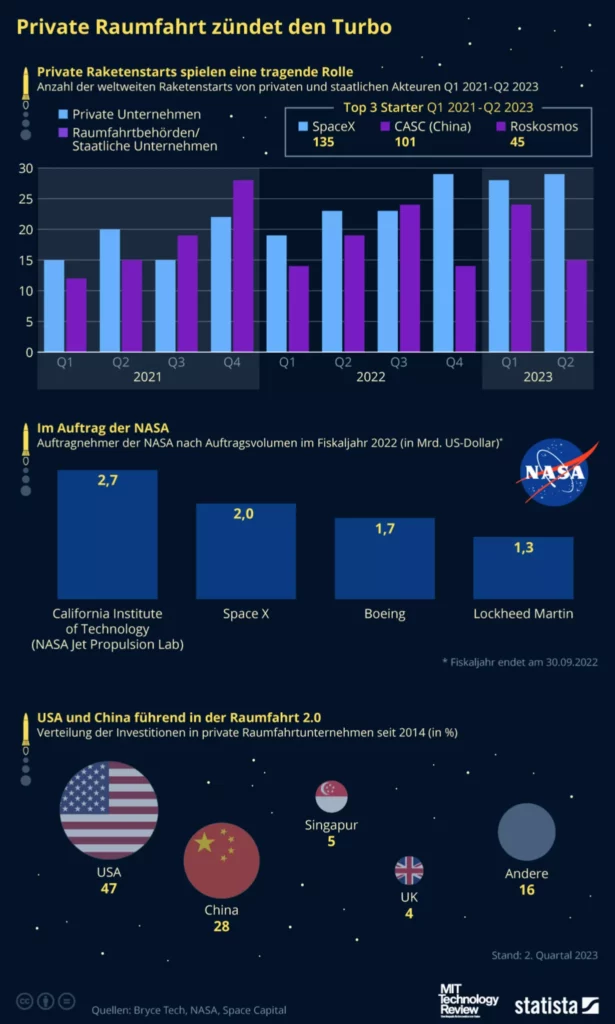
It can be assumed that space travel in the future will be supported primarily by the private sector. At the same time, commercial spaceflight offers high economic value on the one hand, while on the other it is precisely for this reason that it is the focus of legislative attention. Germany, for example, has announced a Space Act to address the regulation of private spaceflight (see “Space Strategy” below). It is to be expected that this will focus from the outset on (IT) security, but also on sustainability in terms of environmental compatibility. It is foreseeable that the approval and testing effort in the EU will increase.
Anwaltskanzlei Ferner Alsdorf

Our law firm specializes in criminal defense and IT law, especially on issues of cybercrime and digital evidence – out of conviction. This website was created out of interest in the topic of space criminal law, which attorney Jens Ferner deals with.
Our Qualification: RA DF has been a specialist lawyer for criminal law for over 20 years; RA JF is a double specialist lawyer, commentator in a renowned commentary on the German Code of Criminal Procedure (StPO), trainee lawyer for the Higher Regional Court of Cologne + lecturer at the Lawyers’ Academy.
Kanzleiwebseite | Kontakt | Impressum | Datenschutzerklärung
Space Strategy of the German Federal Government 2023
The German government has repositioned itself in 2023 and named its space strategy with key projects
Competition & Regulation
Free and independent access to space is, in the government’s view, an essential element of Europe’s strategic sovereignty and thus indispensable for the realization of our political, economic and societal goals in the use of space. In a new global space environment, a new, sustainable approach to the development and procurement of launch services in Europe is required: towards more intra-European competition between private companies.
It is about a paradigm shift in the development and procurement of launcher services in Europe: A European launcher competition is to enter into a competitive model of launcher procurement. This will pave the way for efficient and independent access to space based on fair competition. The principles of sustainability will be integrated throughout the entire life cycle, from the development and production of the launcher to its sustainable operation on the ground and on its way into space.
The German government is also striving for a national space law that will contribute to the sustainability of space activities by, among other things, making licensing and control of space activities mandatory. Legal regulations should also contribute to reliability and to an innovative and competitive location for space companies. In addition, the inclusion of security-relevant aspects is being examined in the drafting of the Space Act.
Participation in international missions and Space Innovation Hub
NASA is identified as an important partner (Mission Grace) as well as Japan (Mission Destiny+). In addition, there is a need for more exchange between public sector users and providers of space services. Procurement processes should become more innovative and transparent, and synergies should be exploited to a greater extent. For this reason, the German government will initiate a platform via the German Space Agency. This Space Innovation Hub will serve as a contact point for the NewSpace scene to develop innovative project ideas and implementation options together with civilian and military players.
The “return” to the moon is also to take place within this framework.
Small satellites
In the view of the German government, small satellites are the engine of the future space market – and a great opportunity for the German space industry, especially for start-ups. That is why the Small Satellites Initiative is being driven forward to pave the way for a closed value chain in Germany. German SMEs and start-ups will be supported in assuming a good competitive position in this market, especially in the development of innovative technologies and services. Research institutions and universities as innovation drivers and breeding grounds for NewSpace approaches will also be taken into account.
Climate and space
Specifically, Germany, in cooperation with UNEP, wants to support the implementation of the goals of the “Methane Pledge” (COP-26, Glasgow) on the level of monitoring and data provision within the framework of the “International Methane Emissions Observatory (IMEO)”. The aim is to create a service for national and European users to verify methane emissions in a targeted manner and ultimately to reduce them systematically.
Furthermore, the potential of earth observation data for natural climate protection (e.g. conservation and renaturation of peatlands and floodplain landscapes) in Germany is to be tapped. To this end, an integrated greenhouse gas monitoring system for Germany is being established. High-resolution satellite measurements of atmospheric greenhouse gas concentrations will enable the quantification of the emission intensity of local CO2 and CH4 sources from space and the improvement of the data flow to finally provide regular source-sink estimates of greenhouse gases on nationally relevant scales by means of a data assimilation and inversion system. Starting with a CO2 monitoring mission from 2026, the Copernicus satellite fleet will be complemented by six additional extension sentinel missions by 2028, which will significantly support the European Green Deal and European climate goals, and will also ensure Europe’s global leadership in Earth observation in the future.
Building on the already existing national and European platforms, the reliable, efficient and user-friendly provision of satellite data and processing tools via cloud platforms is to be further advanced in order to enable, among other things, users from public institutions and science, but also service providers, to have fast, simple and efficient access to globally available Earth observation data, as well as their secure cloud-based processing and integration with their own data.
Space situational picture
The ability to create a space situational picture is an elementary basis for measures to protect space systems and thus for nationwide action in space. The National Security Strategy emphasizes the importance of space situational awareness as a joint civil-military task. In order to ensure the operational availability of an up-to-date and independent space situational picture, we will ensure the development and expansion of national capabilities, including sensor technology, and the operation of the joint interdepartmental space situational awareness center by 2030. In doing so, the existing competencies of research and federal institutions will be expanded. Germany will continue to play a leading role in the EU SST partnership and establish a catalog and service availability for monitoring all relevant Earth orbits.
Space Traffic Management
The number of objects in space is increasing rapidly. Unlike in air traffic, where air traffic control ensures that all aircraft are always at a sufficient distance from each other, there is as yet no corresponding coordination body for outer space. Due to the physical differences, approaches from air traffic are not easily transferable to space traffic. In order to avoid collisions in space, the European Union has developed a political approach to space traffic management, which takes into account in particular the improvement of the EU’s independence in the field of observation and tracking of space objects by the EU Member States, which already cooperate in the EU-SST partnership. Based on the services that EU SST provides free of charge to satellite operators worldwide, collision hazards can be detected and avoidance maneuvers can be performed, among other things.
Germany will actively support the implementation and international representation of the EU approach to STM and has advocated the establishment of an international STM system within the framework of the United Nations. Implementation of Germany’s position requires consistent expansion of national capabilities as well as bilateral and multilateral networking of Germany in the area of space surveillance with civilian and military partners. The continuation of our leading role in the EU SST will be pursued in close coordination with France.
The Munich Higher Regional Court (20 U 3236/22 e) had the opportunity to comment on the obligations of a provider of standard software on the occasion of the termination without notice of a software and license subscription.
An often underestimated problem is the so-called pseudo self-employment: It can happen that someone is self-employed “on paper” and also behaves like this in everyday life. However, case law and the social security funds in Germany can come to the conclusion that an employment relationship is to be assumed despite self-employment. Objective criteria are used for this – and if the apparently self-employed person is then actually classified as an employee, this has unpleasant consequences: Social security contributions must be paid in arrears, which in Germany can quickly run into six figures! In addition, there is the threat of criminal liability for the involuntary employer and suddenly a monthly remuneration obligation if one does not give proper notice.
When does pseudo self-employment exist? The Federal Social Court (B 12 R 7/15 R) had the opportunity to comment on the criteria for the assumption of pseudo self-employment. Especially in the area of IT law and the widespread use of freelancers here, this is a constant minefield. At the time, the court had ruled that it is a weighty indication of self-employment if the agreed fee is significantly higher than the salary of a comparably employed employee subject to social security contributions and thus allows for self-provision. On this occasion, the court also once again discussed the criteria to be used in the examination of a pseudo-self-employment.
When developing software (“software development”) and using it commercially, some legal aspects have to be considered in order to avoid possible legal problems.
In the last few years of my work, the same issues have emerged time and again, some of which are underestimated and others ignored by software developers. The local IT startup industry suffers from something that is rarely observed in this blatant form abroad: the complete refusal of legal assistance. The idea of budgeting a fixed portion for ongoing legal costs overwhelms many – and ultimately leads to unnecessary additional costs.
Untested software is worthless – as far as the truism goes. Especially in the case of further developments or bug fixes in productive environments, not only is testing indispensable, but in particular one must work with real data.
The classic is a further developed customer support system to which the changeover is to be made. As a rule, initial test runs are carried out here (in extracts) with existing customer data records. But is this permissible under data protection law? This question has been controversial up to now, but has now been answered by the EU Court of Justice – quite satisfactorily – in a rough outline.
The violation of sanctions (“embargo violation”) is punishable by considerable sanctions – and especially in the past months it is by no means such an exotic violation that one should not have it on one’s radar. In recent months, our law firm has been confronted mainly with requests for advice in the area of software and technology goods, where the question of import or export arises via quite tricky detours.
The Higher Regional Court of Frankfurt (“OLG”, 11 U 36/18) has commented on the question of whether a reproduction within the meaning of Section 69c No. 1 UrhG also exists if the use of software by way of cloud computing leads to a (technical) reproduction not on computers in the user’s domain, but on third-party servers that are within the sphere of influence of the authorized user.
This question has not yet been decided by the highest court. Some of the literature is of the opinion that there is no reproduction by the user if the accessing client does not receive a copy in the main memory of his computer or if the program is reproduced exclusively on the server of the service provider.
In general, the loading of a program into the RAM of another computer constitutes a reproduction within the meaning of Section 69c No. 1 of the German Copyright Act (UrhG). The main idea is that this loading of a program into the RAM of a computer enables further use of the program by means of further program copies.
The OLG is now of the opinion that the answer to the question of whether cloud computing constitutes an act of copying relevant under copyright law cannot be made dependent solely on the sphere of influence of the computer on which the copying takes place.
According to Section 69c No. 1 Sentence 2 UrhG, the consent of the copyright holder is always required if the “loading, displaying, running, transferring or storing” of the program requires duplication. The right of reproduction is one of the basic exploitation rights of the author (Sections 15 (1) No. 1, 16 UrhG). The basic consequence of reproduction is that the reproduced work can be used in the same way as the work itself (e.g. viewed, read, listened to ….). It thus enables additional enjoyment of the work.According to Section 69c No. 1 Sentence 2 UrhG, the consent of the copyright holder is always required if the “loading, displaying, running, transferring or storing” of the program requires duplication. The right of reproduction is one of the basic exploitation rights of the author (Sections 15 (1) No. 1, 16 UrhG). The basic consequence of reproduction is that the reproduced work can be used in the same way as the work itself (e.g. viewed, read, listened to ….). It thus enables additional enjoyment of the work.
The ratio of Section 69c No. 1 UrhG must also be seen against this background: The mere “enjoyment of a work” does not constitute an act of use relevant under copyright law, even in the case of computer programs. If a user has lawfully acquired a program and installed it on a stationary basis on his own PC, no copyright is infringed if he allows a third party to work with this program on this PC, nor if he allows a third party to watch a film he has acquired there (the OLG refers in this respect to BGH, I ZR 139/89). The use by the third party only becomes relevant under copyright law if the third party is enabled to make further use of the program by copying it. In the opinion of the OLG, however, this legal purpose applies irrespective of the sphere in which the reproduction required for the additional use takes place.
According to the German Federal Labor Court (2 AZR 17/23), an employee who makes strongly insulting, racist, sexist and violent comments about superiors and other colleagues in a private chat group consisting of seven members can only invoke a justified expectation of confidentiality against extraordinary termination of his employment relationship in exceptional cases.