
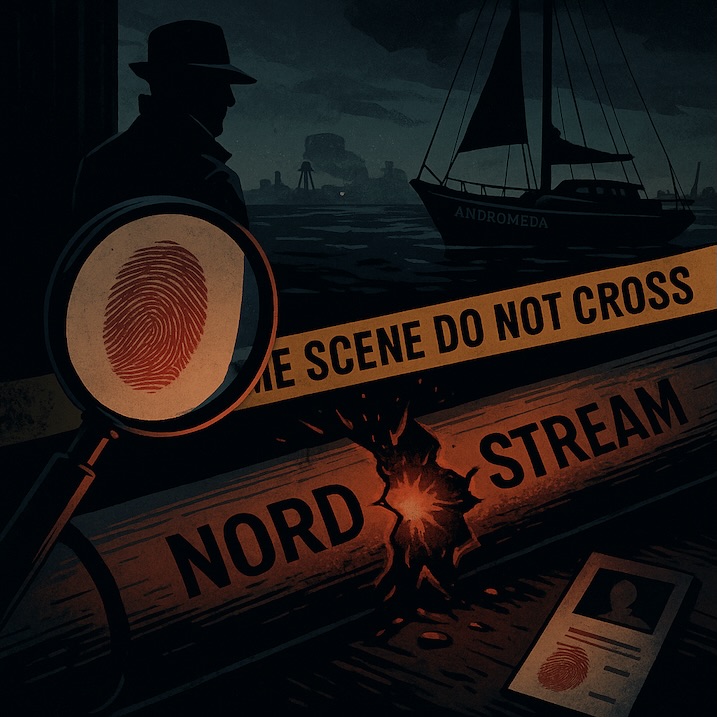
The Baltic Sea as a crime scene, the Andromeda as the vessel, fingerprints and DNA as the quiet but persistent narrators of an operation that left Europe holding its breath in the autumn of 2022: by the summer of 2025, investigations into the attacks on the Nord Stream 1 and 2 pipelines have visibly entered a new phase. According to coordinated research by ARD, Süddeutsche Zeitung and Die Zeit, arrest warrants have now been issued against six Ukrainians; one of the suspects, Serhii K., was arrested in Italy.
Investigators rely on a dense web of traces found aboard the chartered sailing yacht Andromeda, including explosive residues, structural damage, fingerprints and DNA. At the same time, indications point to connections between some of the accused and Ukrainian authorities; the presumption of innocence nevertheless applies, and the question of possible state involvement remains contested. As of late August 2025, no indictment has been filed; the matter remains in the investigative phase.
The accusation
Legally relevant for now is the catalogue of accusations. According to the Federal Prosecutor General, as reported by outlets such as LTO, the suspicion against the arrested suspect focuses on the joint commission of a bomb explosion (§ 308(1) German Criminal Code), unconstitutional sabotage (§ 88(1) No. 3 StGB) and the destruction of structures (§ 305(1) StGB). The arrest was based on a European Arrest Warrant; if extradited, the suspect would be brought before an investigating judge of the Federal Court of Justice. Whether there will be an indictment in Germany depends on further evidentiary consolidation – but the door is clearly ajar.
This places § 88 StGB (“unconstitutional sabotage”) at the center of attention. The provision protects the existence and security of the Federal Republic of Germany as well as the constitutional principles listed in § 92(2) StGB. Doctrinally, § 88 is a “qualified form of property damage” with a state- or constitution-hostile intent: partly an abstract endangerment offense, partly a result offense, and in a way the “completion provision” to § 87 StGB.
Anti-constitutional sabotage in Germany
On the object side, § 88(1) names four categories of critical infrastructure; in the Nord Stream case, No. 3 is most pertinent: enterprises or facilities providing public supplies of water, light, heat or power – in other words, energy – as well as other facilities vital to the population. The statute aims to safeguard the functional integrity of such supply systems in the public interest.
The act is defined as a “disruptive act,” which as a result must render the protected facility wholly or partly inoperative or divert it from its intended purposes. The concept of “causing” is broad, covering not only direct conduct but also failure to act under a duty (omissions) and instigation; what matters is that the offender contributes causally to the result. Not covered are mere reputational harms or journalistic revelations, unless they genuinely paralyze the functioning of the institution.
Perpetrators may be ringleaders or backers of a group, or a single actor; the latter may also be part of a group acting without ringleaders. A group requires at least three individuals united in purpose; no rigid internal organization is needed, leaving the boundaries to terrorist networks deliberately fluid.
The subjective element of § 88 requires double intent: first, intent to achieve the disruptive effect itself (a deliberate act of sabotage); second, intent to support unconstitutional aims within the meaning of § 92(3) StGB – that is, against the existence or security of the Federal Republic or against constitutional principles. Mere knowledge or acceptance is insufficient.
Attempts are expressly punishable; in terms of concurrence, § 88 can overlap with §§ 316b, 317 StGB (disruption of public enterprises/telecommunications) as well as §§ 303b, 305a and 318. Within the system of state-protection offenses, §§ 81–83 (high treason) may take precedence in certain cases; nonetheless, § 88 retains its own space for targeted attacks on critical infrastructures with a constitutional-hostile intent.
In the cross-border dimension, territorial application is delicate. § 88 requires that the sabotage object be located “within the territorial scope of this Act”; however, the disruptive act itself may occur abroad – § 88 is thus structured as a “distance offense.” For transnational energy infrastructure, the decisive issue is whether the attacked object can be functionally and territorially assigned to German jurisdiction. This question will likely be litigated in view of the pipeline routes, as the explosions occurred near Bornholm, yet the supply chain runs into German territory.

Not a simple explosive attack
Applying these standards to the Nord Stream investigations, a legally clear though evidentially demanding picture emerges: the pipelines are plausibly “facilities of public energy supply of essential importance,” and the explosions rendered them at least temporarily inoperative. The classification as unconstitutional sabotage then hinges on whether the intent to endanger the state – the second element of intent – can be proven. This is the real fulcrum, beyond the physical infrastructure component.
Conclusion
The Nord Stream case may become a rare test of § 88 StGB. Factually, the known evidence – from the Andromeda to forensic traces and travel patterns to the arrest in Rimini – supports the suspicion of classic sabotage against energy infrastructure. Whether this escalates into “unconstitutional sabotage” in the sense of the double intent requirement is the legal key question, where evidence, geopolitics and doctrinal nuance will converge in any future trial. Until then, it bears repeating: arrest warrants are not convictions, and the threshold from suspicion to indictment remains a hurdle of rule-of-law sobriety, even under the spotlight of a political thriller.

Availability: By email, callback, Threema or Whatsapp. Information about our fees.
Our law firm specializes in criminal defense, cybercrime, commercial criminal law including criminal tax law as well as IT law and manager liability. We only take on criminal defense cases for consumers—we are based in the Aachen area and operate nationwide.